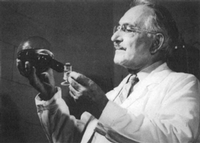
Rutgers Professor of Microbiology Selman Waksman won the 1952 Nobel Prize in
Physiology or Medicine for the discovery of streptomycin. Working at Rutgers’ College of Agriculture, Waksman and his students
spent nearly three decades analyzing soil microbes before they isolated and
identified the antibiotic streptomycin in 1943, which helped combat the scourge
of tuberculosis during the 20th century.
Waksman and most of his co-workers are long gone, but his legacy lives on.
With the emergence of drug resistant bacteria that cause diseases, such as
tuberculosis, the search for new antibiotics has become a priority. At Rutgers’
Biotechnology Center for Agriculture and the
Environment, molecular biologist Gerben Zylstra leads an initiative that picks
up where Waksman left off, but now employing molecular tools
to streamline and accelerate laboratory processes.

The first challenge the new generation of researchers face, however, is that
the discovery potential of our local soils was exhausted by Waksman’s group. Continued
soil testing would only show bacteria they had already found, over and over.
Thus, the search for the small number of as yet undiscovered microbes and
antibiotics has become a much more challenging and labor intensive process.
But shifting the search to the other side of the world has now expanded the
horizons for discovery. Through Professor Ilya Raskin’s Global Institute for
BioExploration, Zylstra is working with microbial biochemist Jerry Kukor and
marine microbiologist Lee Kerkhof in the central Asian republic of Kyrgyzstan. The
unexplored soils in this exotic locale contain unique bacteria that the
researchers hope will yield new and different chemicals with antibiotic
properties.
These 21st century researchers are still faced with the arduous
task of screening the

thousands of new Asian soils and microbes in the hope of
finding new antibiotic chemicals.
The Rutgers team is now employing
sophisticated molecular tools, first in pre-screening the soils for the DNA of
new microbes or of new ways to produce chemicals. If the sample tests positive,
they isolate the bacteria that match the test results, and grow them to produce
the chemicals which are then analyzed for antibiotic potential.
However, some bacteria cannot grow in the laboratory – only in their home
soils – so a different approach is used, called metagenomics. This is the pursuit of genetic information in the
absence of lab cultures of microbes, a field in which School of Environmental
and Biological Sciences Dean Robert M. Goodman did some pioneering work.
In this cutting-edge technique, researchers isolate all of the DNA from a soil
sample and clone it. The particular bacterium need not be identified. The focus
is solely on finding genes that make chemicals that may have antibiotic
properties.
“You can go directly after those genes and fish them out, put them in a
bacterium that you can work with in the lab and, hopefully, it will start to
make something that’s new and different,” Zylstra explained.