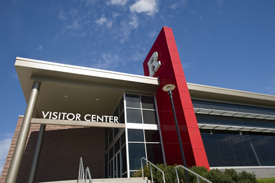
In Rolando Herts’s vision, universities both public and private can play a vital role in generating tourism – and tourism dollars – a boon especially when those schools are located in economically distressed communities.
The Rutgers doctoral student is examining how institutions of higher learning might partner with local stakeholders to position themselves as tourist destinations, using two regions and the universities located in them as case studies.
Herts’s work focuses on New Jersey’s Gateway Tourism Region, which includes Rutgers’ Newark and New Brunswick campuses, and the Mississippi Delta region, with Delta State University and Mississippi VHertsalley State University.
By sharing their expertise with convention and tourism bureaus, municipal officials, chambers of commerce, and festival planners, Herts believes that academics can help energize a grass-roots movement to bring visitors to the nations' campuses and their environs.
“There are all kinds of possibilities, especially with the recent advent of ‘staycations’ during the recession,” said Herts, who is completing a Ph.D. in urban planning and policy development at the Edward J. Bloustein School of Planning and Public Policy under the direction of tourism expert Briavel Holcomb. “Universities as cultural institutions and repositories of history have a lot to offer both local residents and out-of-town visitors.”
For his dissertation – “The Roles of Universities in Tourism Planning and Development” (working title) – Herts chose venues with which he’s particularly familiar.
In addition to completing a commitment with Teach for America in the Mississippi Delta after receiving degrees from Morehouse College in Atlanta and the University of Chicago, he serves as associate director of the Office of University-Community Partnerships (formerly the Office of Campus and Community Relations) on the Newark Campus.
Working with Diane Hill, assistant chancellor for university-community partnerships, Herts is exploring ways to apply his research to engagement efforts linking Rutgers and Newark.
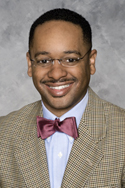
The graduate student comes by his passion naturally. His mother is a retired school district administrator and assistant dean of education, and his father, currently a university dean, was the first African-American superintendent of schools in an Arkansas Delta town that was still segregated in the 1980s.
Herts said he has long been intrigued by what he calls the “community-building capacity” of schools and universities.
“People coming from all over the world to attend school and academic conferences in Newark, for example, may hear all the negatives, but why not find ways to expose them to the positives?” he suggested, like the city’s Ironbound District, with its Portuguese and Spanish restaurants; the Cathedra Basilica of the Sacred Heart, a national historic landmark; and downtown Newark, with its thriving arts and entertainment scenes.
“How might we at Rutgers be able to build on those treasures using the expertise and experience of people at the university and in the community?” Herts wondered. He sees a symbiosis developing to create a pride of place, spurred partially by campus information and visitor services – in many instances the first points of contact students and their families have with a university and its host community.
Herts is reaching out to faculty members, administrators, community activists, and tourism and community-development experts to gauge the current level of engagement and the potential for future partnerships.
He noted that institutions such as Rutgers, the University of Wisconsin-Madison, and Stanford University market on-campus museums, galleries, gardens, and historic structures as tourist attractions through campus-visitor information websites, while some state universities like North Carolina State and Texas A&M advise local communities on agritourism and festival planning through cooperative extensions.
Others serve as management entities for National Heritage Areas (NHAs), regions designated by Congress for their distinctive natural, cultural, historic, and scenic resources. For example, he said, the University of North Alabama manages the Muscle Shoals NHA, a site rich in history pertaining to Native Americans as well as the transportation and music industries. Delta State University and Mississippi Valley State University both are eligible to become the management entity for the Mississippi Delta NHA, where cotton, culinary arts, and Blues music are prominent cultural heritage themes.
Although Rutgers does not manage a NHA, its three campuses are located within the boundaries of the Crossroads of the American Revolution NHA, with Old Queens Campus identified as one of the NHA’s many historic assets.
In the end, Herts believes, the type of partnership he is tracking not only will improve a university’s engagement with its community but also has the potential to educate and revitalize an entire region.